
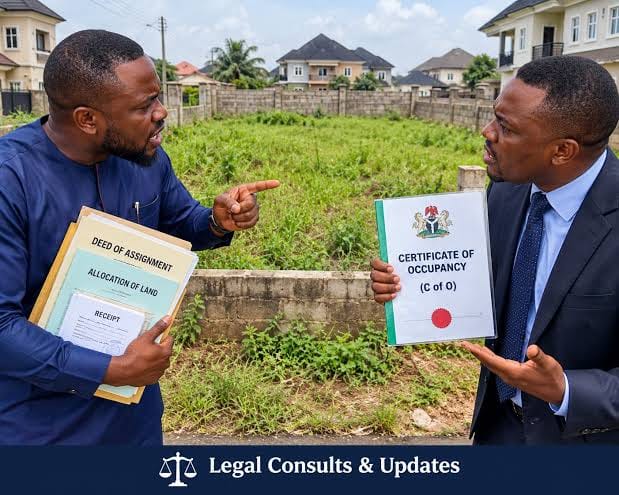
HOW TO PROVE OWNERSHIP OF LAND IN NIGERIA: THE FIVE RECOGNISED METHODS AND THEIR EVIDENTIAL REQUIREMENTS
HOW TO PROVE OWNERSHIP OF LAND IN NIGERIA: THE FIVE RECOGNISED METHODS AND THEIR EVIDENTIAL REQUIREMENTS
Introduction
A person who claims ownership of land may need to prove that claim in court—for example, in a claim for a declaration of title, recovery of possession, or an injunction against trespass. Nigerian courts recognise five methods of proving title to land. The Supreme Court set them out in Idundun v Okumagba (1976) 9–10 SC 227, and has repeatedly restated them.
The five methods are:
- Traditional evidence;
- Production of documents of title;
- Acts of ownership;
- Acts of long possession and enjoyment; and
- Possession of connected or adjacent land.
A claimant need not prove all five. One method, established by credible and sufficiently cogent evidence, can be enough. The claimant must, however, identify the land claimed and show that the method relied on actually proves a valid title to that land.
The word “ownership” also needs context. Under section 1 of the Land Use Act 1978, all land in a state is vested in the Governor to be held in trust and administered for the use and common benefit of Nigerians. In practice, claims to land usually concern a right of occupancy, customary interests, or a derivative interest such as a leasehold. The evidence required depends on the nature of the interest claimed and how it was acquired.
The Claimant Must Prove Their Own Case
In a claim for a declaration of title, the claimant carries the burden of proving entitlement to the declaration on the strength of their own evidence. A defendant’s weak case does not, by itself, establish the claimant’s title. The court must be satisfied that the claimant has proved a recognised method of title and that the land covered by the claim is sufficiently identifiable.
The case is assessed on the civil standard: the balance of probabilities. But a declaration of title is not granted merely because the defendant admits the claim or fails to produce convincing evidence. The claimant must establish the claim through credible evidence.
The identity and boundaries of the land are a separate and essential issue. A claimant must show the area to which the requested declaration should attach, by clear oral evidence, a survey plan, or both. A survey plan is particularly important where the boundaries are disputed or the description alone does not make the land ascertainable. Dudu Addah v Ubandawaki (2015) 4 NWLR (Pt 1450) 431 confirms that a claimant may establish identity through oral evidence or a plan that clearly shows the area claimed.
Proof By Traditional Evidence
Traditional evidence is commonly used where a party claims through an original founder, family, community, or customary grant. The claimant must give a coherent account of how the land was first acquired and how title passed through successive generations or owners to the claimant.
The evidence should ordinarily establish:
- who first founded, settled on, or acquired the land;
- how that person acquired it;
- the acts by which the founder exercised ownership;
- the successive persons through whom the land devolved; and
- how it eventually became vested in the claimant or the family or community represented by the claimant.
The chain must be explained. Material gaps, unexplained changes in ownership, or conflicting accounts may undermine the claim. In Oyadare v Keji (2005) 7 NWLR (Pt 925) 571, the Supreme Court addressed the requirement to plead and prove the traditional root relied on. It also held that a party who pleaded a particular traditional root but failed to prove it could not simply fall back on acts of ownership or possession to prove that same, failed root.
A witness’s personal knowledge of every historical event is not always possible. But the claimant must explain the source of the history and show that the witnesses’ account is credible. Evidence that a family has “owned the land from time immemorial,” without the necessary account of the founder and devolution, may be insufficient where the root is disputed. The Supreme Court discussed the need for a credible traditional account in Lawani Alli v Alesinloye (2000) 6 NWLR (Pt 660) 177.
Traditional evidence is not confined to oral recollection. Documents, boundary evidence, community records, earlier proceedings, and acts consistent with the account may support it. They do not automatically cure a missing or contradictory chain.
Proof By Documents Of Title
A claimant may rely on a deed of conveyance, deed of assignment, grant, certificate of occupancy, registered instrument, or another document said to confer an interest in the land. The document must be admissible and must genuinely relate to the land and interest claimed.
In Romaine v Romaine (1992) 4 NWLR (Pt 238) 650, the Supreme Court identified questions a court may need to consider when a party relies on an instrument of title:
- Is the document genuine and valid?
- Was it duly executed, stamped and, where required, registered?
- Did the grantor have the capacity and authority to make the grant?
- Did the grantor own or hold the interest purportedly granted?
- Does the document have the legal effect claimed for it?
The Supreme Court reiterated these requirements in Akinduro v Alaya (2007) 15 NWLR (Pt 1056) 1.
Producing a document is therefore not necessarily enough. The claimant may need to prove its execution and authenticity, establish a proper basis for admitting it, and connect its description to the disputed parcel. A registered document may assist with proof, but registration does not by itself establish that the grantor had good title to pass.
Where the grantor’s title is challenged, the claimant may have to trace the grantor’s interest to a valid root. In Ogunleye v Oni (1990) 2 NWLR (Pt 135) 745, the Supreme Court explained that a certificate of occupancy is prima facie evidence of a right of occupancy, but that presumption may be displaced by proof of an earlier valid title. The Court also held that a grantee relying on a grant may have to establish the grantor’s title if it is disputed.
There is also a difference between proving a document exists and proving that it legally transferred an interest. Under sections 22 and 26 of the Land Use Act, certain alienations of a statutory right of occupancy require the Governor’s consent, and a transaction or instrument purporting to confer an interest otherwise than in accordance with the Act may be void. The legal effect of a particular transaction depends on its terms and circumstances; the Supreme Court considered the operation of these provisions in Brossette Manufacturing Nigeria Ltd v Ola Ilemobola Ltd (2007) 14 NWLR (Pt 1053) 109.
Registration and stamping requirements also depend on the applicable federal and state legislation and the type of instrument. A lawyer reviewing a land document should check the law applicable to the location of the land and the date and nature of the transaction.
Proof By Acts Of Ownership
A claimant may establish title by showing acts of ownership that are numerous, positive, and spread over a sufficient period to support the inference that the claimant—or a predecessor in title—was the true owner.
Examples may include:
- selling or granting portions of the land;
- leasing or letting it to others;
- farming or developing it;
- building on it;
- exercising control over access;
- granting permissions to occupy or use it; or
- dealing with the land in a way that an owner ordinarily would.
The acts must relate to the land in dispute and be sufficiently clear to support the inference of ownership. Occasional entry, isolated cultivation, or a single act may not be enough. Nor does every act of occupation necessarily show ownership: it could be consistent with a tenancy, permission, or another limited right.
The court considers the number, nature, duration, and consistency of the acts, along with evidence from the opposing party. Idundun v Okumagba recognises this method, drawing on the principle in Ekpo v Ita (1932) 11 NLR 68 that acts relied on should be sufficiently numerous and positive to warrant an inference of ownership.
Where the claimant pleads a specific root of title, such as a grant or traditional devolution, the evidence of acts should support that pleaded case. A claimant should not assume that acts of ownership will rescue a case built on a particular root that has failed in proof.
Proof By Acts Of Long Possession And Enjoyment
Long possession and enjoyment may provide prima facie evidence of ownership or a right of occupancy. Section 46 of the Evidence Act 2011 provides that acts of possession and enjoyment may be evidence of ownership or a right of occupancy over the particular land and, in appropriate circumstances, over connected land. Earlier cases refer to the corresponding provision as section 45 of the former Evidence Act.
Evidence may include occupation, cultivation, construction, collection of rents, fencing, maintenance, or other sustained use. The court will consider how long the possession lasted, whether it was open and continuous, whether it was exclusive or disputed, and whether it is consistent with the title claimed.
Long possession is not automatically conclusive. A person may possess land as a tenant, licensee, caretaker, family member, or trespasser. Possession may therefore need to be explained and connected to the claimant’s asserted basis of title. In Salami v Lawal (2008) 14 NWLR (Pt 1108) 546, the Supreme Court cautioned that possession, by itself, does not always prove ownership; its significance depends on the surrounding evidence.
A claimant relying on possession should be ready to provide witnesses and records that establish when possession began, how it was exercised, and whether anyone challenged it. Receipts, tenancy records, photographs, building approvals, utility documents, or community evidence may help to corroborate the account, although their value depends on what they actually prove.
Proof By Possession Of Connected Or Adjacent Land
A claimant may rely on possession of adjoining or connected land where the circumstances make it probable that the person who owns the connected parcel also owns the disputed land. This is an inference from the relationship between the parcels, not an automatic rule.
The claimant should establish:
- the claimant’s title or possession of the connected parcel;
- the location and boundaries of both parcels;
- how close or connected they are; and
- why the relationship between the parcels supports the inference of common ownership.
A survey plan, boundary witnesses, physical features, and evidence of the history of both parcels may be relevant. The inference is weaker where the parcels are separated, where their boundaries are uncertain, or where another person has independently occupied or claimed the disputed parcel.
The principle appears in Idundun v Okumagba and is connected to section 46 of the Evidence Act 2011, which permits acts of possession and enjoyment to be relevant to other land sufficiently connected by locality or similarity.
Land Identification And Evidence That Supports More Than One Method
Whichever method is used, the court must be able to identify the land covered by the claim. The claimant should describe its location, boundaries, dimensions, neighbouring properties, access, and any distinctive features. Where the description is disputed or inadequate, a survey plan prepared by a qualified surveyor may be necessary.
A plan is evidence of the land’s location and boundaries; it is not itself proof that the claimant owns that land. Similarly, a receipt, allocation paper, building approval, or tax record may support part of the claim without establishing the full title. Each item must be assessed for the specific fact it proves.
Evidence may support more than one of the five methods. For example, a deed may be accompanied by evidence of the vendor’s title, the claimant’s possession, and acts of ownership. But the pleadings should make clear what basis of title is being advanced, and the evidence should remain consistent with that case.
Practical Evidence Checklist
A person preparing to prove title should gather, where available:
- the title documents and earlier instruments in the chain;
- evidence showing how the original owner acquired the land;
- evidence connecting each transfer or devolution to the claimant;
- a survey plan and a clear description of the boundaries;
- evidence of possession, occupation, development, or dealings with the land;
- witnesses who know the relevant history or can explain their knowledge;
- consent, registration, stamping, probate, or administration documents relevant to the transaction; and
- search results or official records that may confirm or contradict the claimed title.
No single checklist guarantees success. The documents and witnesses must be tested against the particular root of title, applicable legislation, land description, and any competing claim.
Conclusion
Nigerian law recognises five routes for proving title to land: traditional evidence, documents of title, acts of ownership, long possession and enjoyment, and possession of connected or adjacent land. A claimant may succeed through one well-proved method, but must establish a coherent and credible case, identify the land precisely, and meet any legal requirements affecting the interest claimed.
The central lesson of Idundun v Okumagba and the cases that followed it is that title depends on the evidence and legal effect of the claimant’s particular case. A document, a period of occupation, or a family history may be important, but none should be treated as conclusive without examining what it proves and how it connects the claimant to the land.
For more information or enquiries, reach out to us at info@guidancelawyers.com, or 07087923643 and 08160799342
Leave a Reply